
How to Find Who Owns a Dutchess County Property
Ownership questions in Dutchess County rarely have one clean answer. The parcel grid links a street address to a parcel number. It also gives a dated assessment owner and a deed reference. That is a strong start. But the tax roll name follows the assessment cycle. So it can trail a fresh transfer. The Clerk's deed records tell you what was actually recorded. A plat or GIS map shows where the parcel sits. Pull the parcel card. Then confirm with the newest recorded deed before you trust any single name. Each record is maintained by a different office, so verify with the one responsible.
- Record the source, parcel grid, and effective date
- Read the field with its record type, source date, and stated legal limits.
- Record the source, parcel grid, and effective date
- Record the source, parcel grid, and effective date
Where Dutchess County Owner Information Comes From
Dutchess County builds its owner information from several sources that serve different purposes. The assessor keeps the parcel grid and the tax roll. The assessor also maintains the dated owner-of-record field that feeds each parcel card. The County Clerk records deeds and other instruments. Those filings create the deed records that carry legal weight. Maps, plats, and tax bills round out the picture from other angles. None of these offices duplicates another's work. A parcel card reflects the assessment cycle. The deed records reflect what has been recorded. That gap is why a single lookup can mislead. Match the parcel number across systems. Keep the source date in mind. Confirm results with the office that maintains the record.
| Source | Owner Info It Gives | Access |
|---|---|---|
| Assessor / tax roll | See the dated official county record | See the dated official county record |
| Recorder deed index | See the dated official county record | See the dated official county record |
| Secretary of State | See the dated official county record | See the dated official county record |
| GIS parcel viewer | See the dated official county record | See the dated official county record |
Owner data in Dutchess County comes from distinct offices with distinct jobs. The assessor maintains the parcel grid and the tax roll. It also holds the dated owner-of-record entry for each parcel. The Clerk's office records deeds. Its deed records show the instruments that actually transfer interests in land. Plat maps and the tax bill add shape and cost detail from yet other sources. The assessment cycle and the recording date move on different clocks. Because of that, a name on a parcel card can lag the newest deed. Compare the parcel number and dates across systems. Then confirm with whichever office holds the record.
What "Who Owns This Property" Cannot Tell You
A Dutchess County ownership lookup has real limits. The tax roll owner is a dated assessment field, not a title opinion. The newest deed may affect only part of an interest, or need legal interpretation. A mailing address is a notice field. It proves nothing about who lives there. Public property records support lawful land research. They do not replace a title search, a survey, an appraisal, or proof of occupancy. Treat each record as one piece, and verify with the office that maintains it.
Lawful use. Read the field with its record type, source date, and stated legal limits.
Dutchess Ownership Method
Start with the structure address in ParcelAccess. Copy the parcel grid, the owner-of-record name, and the mailing address. Also copy the roll year and the deed reference. Next, take that owner to the County Clerk index and search for them as grantee. Confirm the newest conveyance touching the same parcel. If the names do not match, compare the March 1 taxable-status date, the recording date, and the legal description. Draw no conclusion before those checks. Keep in mind that a mailing address is only a notice field. An assessor name is a dated tax-roll entry rather than a title opinion.
- Match the address to the grid.
- Read the dated assessor owner.
- Open the newest deed reference.
- Compare parcel and parties.
Dutchess Entity Owners
The owner of record is not always a person. An LLC, corporation, trust, estate, or group of co-owners can hold the parcel instead. Copy the name exactly as shown on the deed. Then try reasonable punctuation and initial variants in the Clerk index. For entities, New York's Corporation and Business Entity Database lists the current name, organization date, jurisdiction, and county location. It also shows the service-of-process address, registered agent, status, and filing history. That detail helps, but it does not replace the deed. Estate ownership may reach the Surrogate's Court before the chain of title becomes clear.
Dutchess Owner Privacy Limits
Public owner fields have legal limits. New York's Address Confidentiality Program gives qualifying participants a substitute address with mail forwarding. Separate confidential voter registration rules apply as well. A mailing address tells you nothing about occupancy. Parcel data must never be used to harass or target a person. Deed Watch can alert a subscriber when a new deed or mortgage appears under a name. But the filing itself still has to be checked with the Clerk.
What Dutchess Ownership Does Not Show
An ownership lookup in Dutchess County answers a narrow question. It does not show who occupies a building. It cannot confirm that every private claim is resolved. It will not place a boundary on the ground. ParcelAccess can lag a newly recorded transfer because its owner field follows the assessment cycle. The Clerk index may hold an instrument that affects only part of an interest. It may also demand legal interpretation. Compare dates and legal descriptions instead of forcing one name to answer everything. A lookup is never a title examination.
When an address search fails, work the problem from other angles. Address Info-Finder can pin down the structure location first. Then search Parcel History by municipality, name, lot, grid, or filed map. Older records carry older names. Beacon parcels may appear under Fishkill Landing or Matteawan. Poughkeepsie deeds may use a vanished street or river-lot name. The assessment-roll PDF is a dated fallback. When a web portal stops, other paths remain. The Record Room, the local assessor, the city office, the library, and the archives still provide access.
Dutchess Court Party Search
The official NYSCEF help source lets guests search filings by party name.
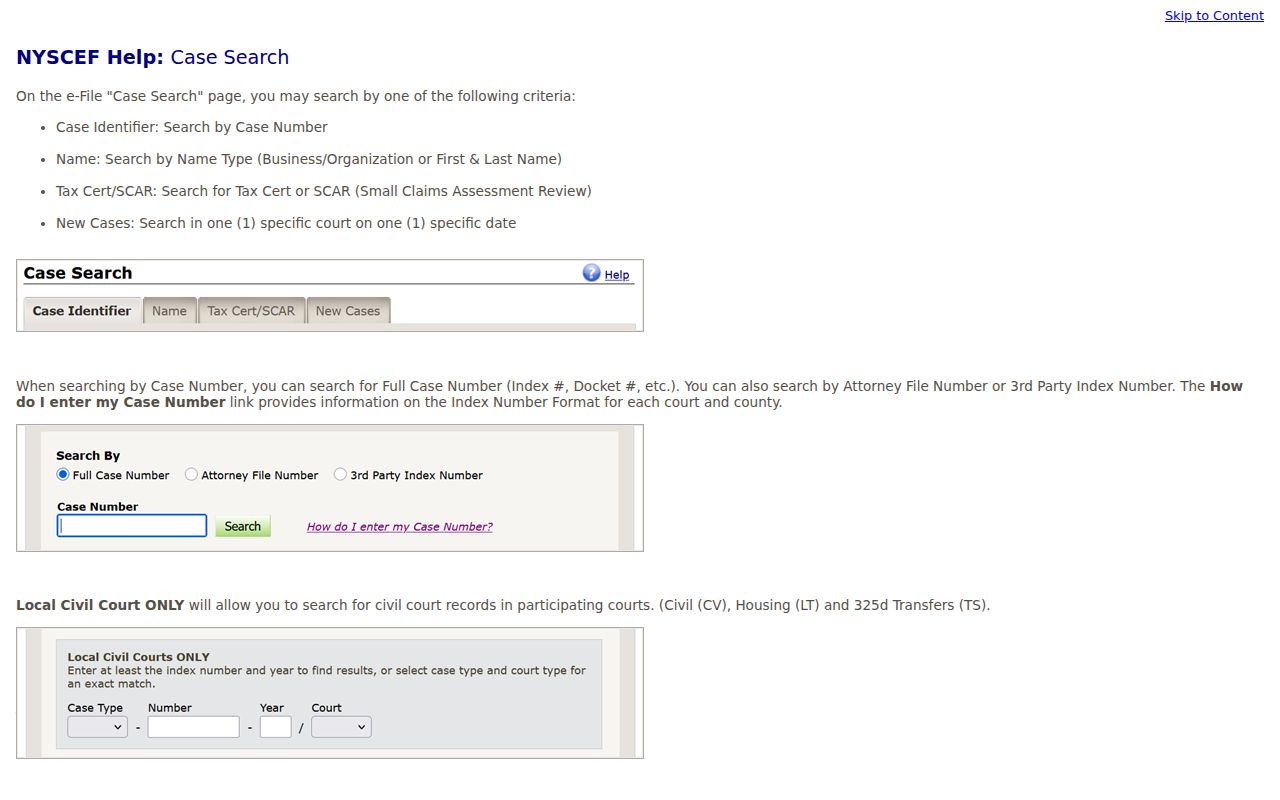
Court results can clarify an estate or a dispute. They cannot replace the dated assessment and the newest recorded deed.
Close out the ownership note with the parcel number and the name of the owner of record. Add the source you used and an effective date. Dutchess County records do not always agree. The assessment roll and the deed records may point to different owners. Report both. Do not guess which screen is fresher. Ask the assessor to confirm the tax roll entry. Ask the County Clerk for the recorded instrument behind it. That method answers who owns the property as far as Dutchess County property records support. It leaves a clear limit where title, estate, or entity questions remain open. The cited source stays the authority for the current record.