
What the Dutchess County Current Owner Record Shows
A Dutchess County current owner record is a bundle of pieces. It is not one tidy answer. The address links to a parcel grid, a dated assessment owner, a recorded deed, the tax roll, and a map layer. Search by address or by name. Save the source date on every result. Confirm details with the office that keeps each record. A parcel card, a Clerk instrument, and a municipal file can disagree. None of them alone proves title, replaces a survey or appraisal, or shows who actually occupies the property.
| Owner of Record | See the dated official county record |
|---|---|
| Vesting / Tenancy | See the dated official county record |
| Mailing Address | See the dated official county record |
| Situs Address | See the dated official county record |
| Deed Reference | See the dated official county record |
| Ownership Since | See the dated official county record |
The current owner of record in Dutchess County shows up in several places at once. The parcel grid anchors the address. A dated assessment owner appears on the roll. The recorded deed, the tax bill, and the plat or GIS map each add their own layer. Search by address or name. Keep the source date with each finding. Check the parcel card against the latest County Clerk instrument and the correct municipal record before drawing conclusions, since lawful land research here is about comparison, and public data is not a title search, survey, appraisal, or proof of occupancy.
Confirming the Current Owner in Dutchess County
Confirming ownership in Dutchess County means comparing what the county's own systems say on their own dates. The parcel grid connects the address. The assessment roll lists a dated owner. The Clerk's deed records carry the recorded instrument, the tax roll tracks the bill, and the map ties it all to the ground. Search by address or name. Note the source date each time. A parcel card should sit beside the newest Clerk instrument and the right municipal record, because public data supports lawful research but never stands in for a title search, survey, appraisal, or proof of occupancy.
- Record the source, parcel grid, and effective date
- Read the field with its record type, source date, and stated legal limits. to confirm vesting
- Record the source, parcel grid, and effective date
- Record the source, parcel grid, and effective date
- Owner of record
- Read the field with its record type, source date, and stated legal limits.
- Vesting
- Read the field with its record type, source date, and stated legal limits.
- Registered agent
- Read the field with its record type, source date, and stated legal limits.
Reaching a Dutchess County Property Owner
Reaching a Dutchess County property owner works best when the record itself is assembled first. Official records connect the address to the parcel grid. They also tie in the dated assessment owner, the recorded deed, the tax roll, and the map. Search by address or name. Keep every source date. Then confirm each detail with the office that maintains it. The county systems answer different questions. So match the parcel card to the latest Clerk instrument and the correct municipal record before relying on a mailing address or roll name. Remember that public data is not a title search, survey, appraisal, or proof of occupancy.
Lawful use. Read the field with its record type, source date, and stated legal limits.
Dutchess Owner Record Timing
The current owner field in ParcelAccess comes from a dated assessment system. That March 1 taxable-status owner can linger on a tentative or final roll. This can persist long after a sale closes. The newest Dutchess County Clerk deed for the same parcel grid and legal description is the stronger record. It shows who owns now. When the two disagree, note both dates. A permit applicant, a tax-bill recipient, or a mailing contact can offer useful context. None of them replaces the deed grantee as the owner of record.
- Owner of record
- The name carried by a specified official record.
- Situs
- The property's physical location.
- Mailing address
- The address used for notices.
- Vesting
- How the deed states that title is held.
Dutchess Current Owner Checks
Use the complete grid every time. A partial match on a street name invites error. From the parcel card, save the municipality, land use, school district, deed book and page, and assessment year. Save these along with the owner name. In the Clerk index, narrow the grantee search by municipality and recording date. Then open the instrument itself. Copy LLC, trust, estate, and multiple-party ownership exactly as written. New York's entity database can clarify an LLC or corporation. Surrogate's Court may explain an estate transfer. Neither source changes what the recorded deed says.
Deed Watch as an Alert
Dutchess Deed Watch is a free, name-based alert service. It flags newly recorded deeds and mortgages after they are filed. The program launched in January 2025. It helps an owner spot an unexpected filing quickly. It cannot block a document, rule on fraud, or refresh ParcelAccess. If a notice looks wrong, inspect the Clerk record. Verify the parcel and the parties. Then contact the Clerk directly. The current owner question still comes down to one thing. It is a dated comparison of assessor and deed records.
Dutchess Owner Record Card
A solid current-owner record card holds the whole picture in one place. Include the complete parcel grid, the municipality, the situs address, the owner name exactly as displayed, and any separate mailing address. Add the roll or taxable-status date, the deed book and page, the newest Clerk recording date, and any unresolved difference. Keeping these fields side by side prevents a familiar mistake. Someone presents a tax-roll name, a permit applicant, or a mailing recipient as timeless proof of title. It is nothing of the sort.
When the owner of record stays unclear, ask the local assessor about the roll field. Ask the County Clerk about the recorded instrument. A targeted FOIL request can reach a city or county file. Such files are not posted online. FOIL does not oblige an agency to answer a title question, though. Report only the dated records. A gap between them can reflect ordinary update lag, an estate, a trust, or an entity. It can also signal multiple-party vesting, or a filing that needs professional review.
Dutchess Parcel Identity Fields
The official ParcelAccess example shows how identity and assessment fields sit together.
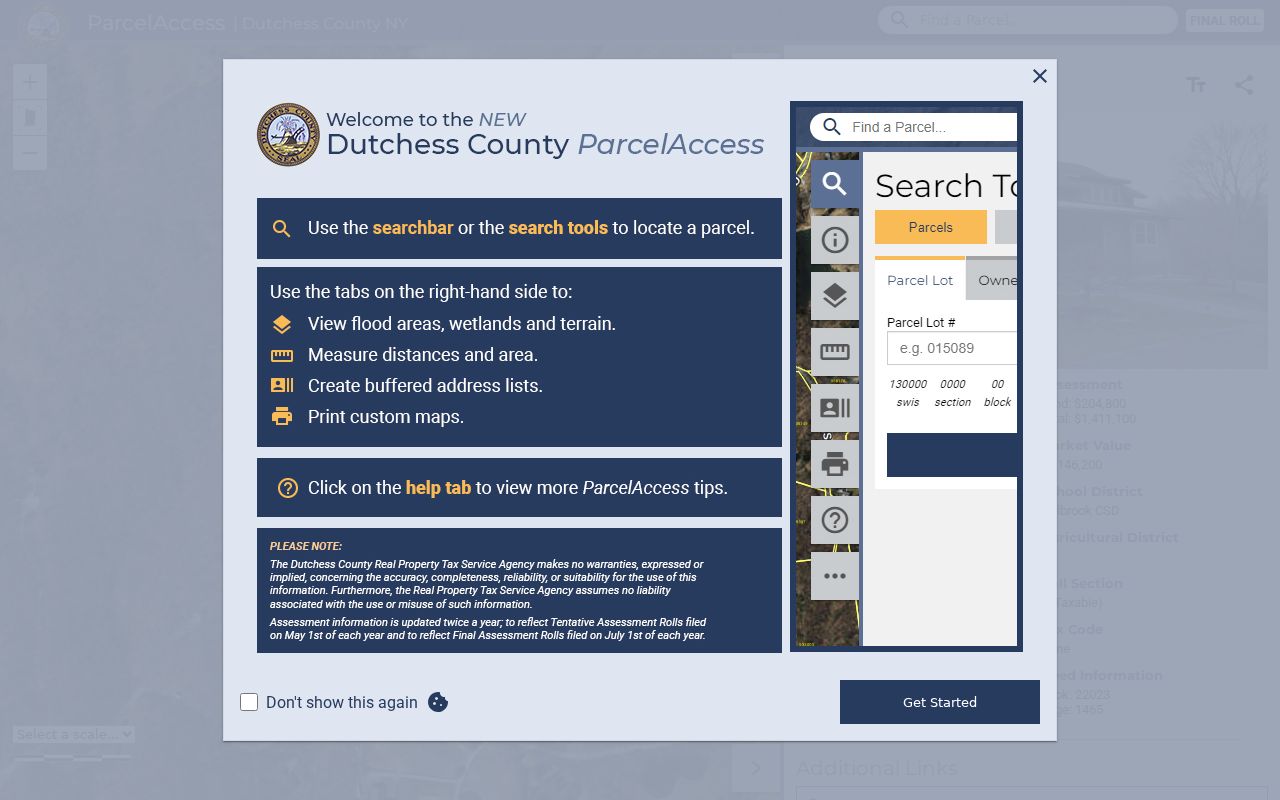
Before confirming the latest deed, read the owner name, mailing address, municipality, grid, and deed reference together with the date displayed on the record.